
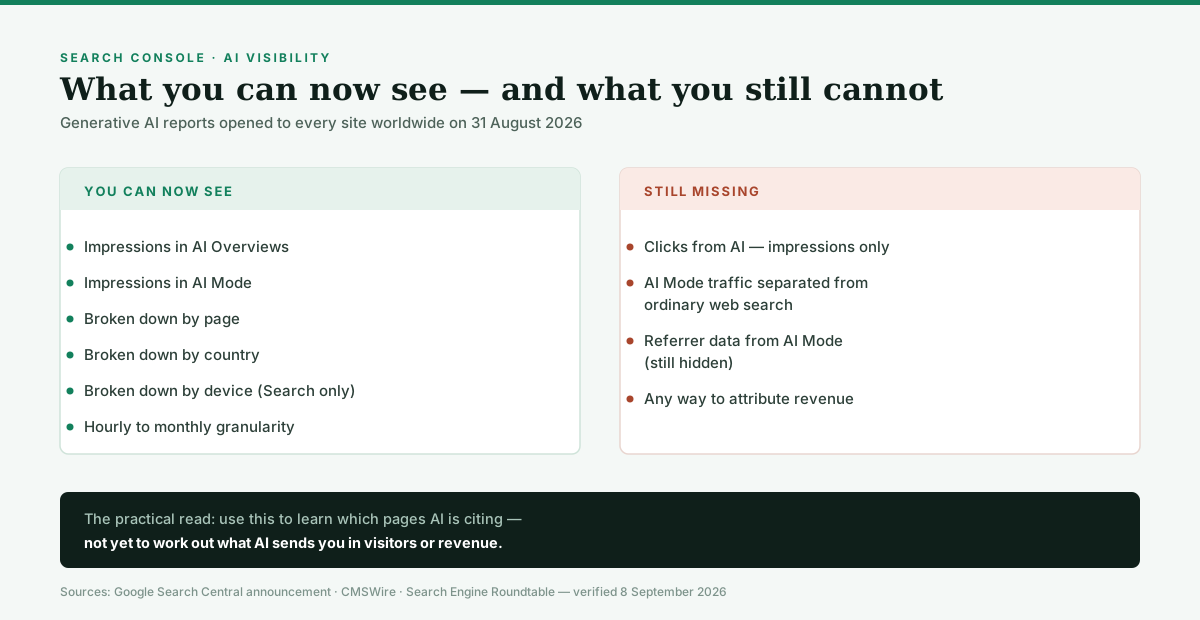
Google made its generative AI performance reports available to every website worldwide on 31 August 2026, letting site owners see in Search Console how often their pages appeared inside AI Overviews and AI Mode, broken down by page, country, device and date. The reports show impressions only - not clicks - which is the single most important thing to understand before drawing conclusions from them.
The reports began rolling out to a subset of sites on 3 June before the August expansion. They sit in the Performance section alongside the familiar web search report, and cover AI Overviews, AI Mode in Search, and the generative features in Discover. Granularity runs from hourly to monthly.
Google also added a control that lets a site opt out of AI features entirely.
The gap that matters
Three limitations shape what these numbers can honestly tell you.
- Impressions, not clicks. You learn that AI surfaced your page. You do not learn whether anyone came to your site because of it.
- AI Mode traffic is not cleanly separated. In the broader Performance report it blends into standard web search, so a rise in sessions cannot be confidently attributed to AI.
- Referrer data from AI Mode stays hidden. Analytics cannot tell you a visit originated in AI Mode, which leaves attribution guesswork.
Put together: this is a visibility report, not a traffic report and certainly not a revenue report. Treating it as the latter is how teams end up reporting growth that did not happen.
What to actually do with it
- Find which pages AI already cites. That list is the most useful output. Those pages have a format AI finds quotable - study what they have in common and apply it elsewhere.
- Watch the trend, not the absolute number. Impressions climbing month over month is a real signal. The raw count compared to anyone else's is not.
- Check which countries. AI features roll out unevenly by market, and the country breakdown explains swings that otherwise look random.
- Do not report it as traffic in any dashboard where someone will read it as visitors.
What Google says you should do about it
Google's own documentation is unusually blunt on this point, and it is worth quoting before anyone sells you an "AI optimisation" package.
The best practices for SEO remain relevant for AI features in Google Search. There are no additional requirements to appear in AI Overviews or AI Mode, nor other special optimizations necessary.
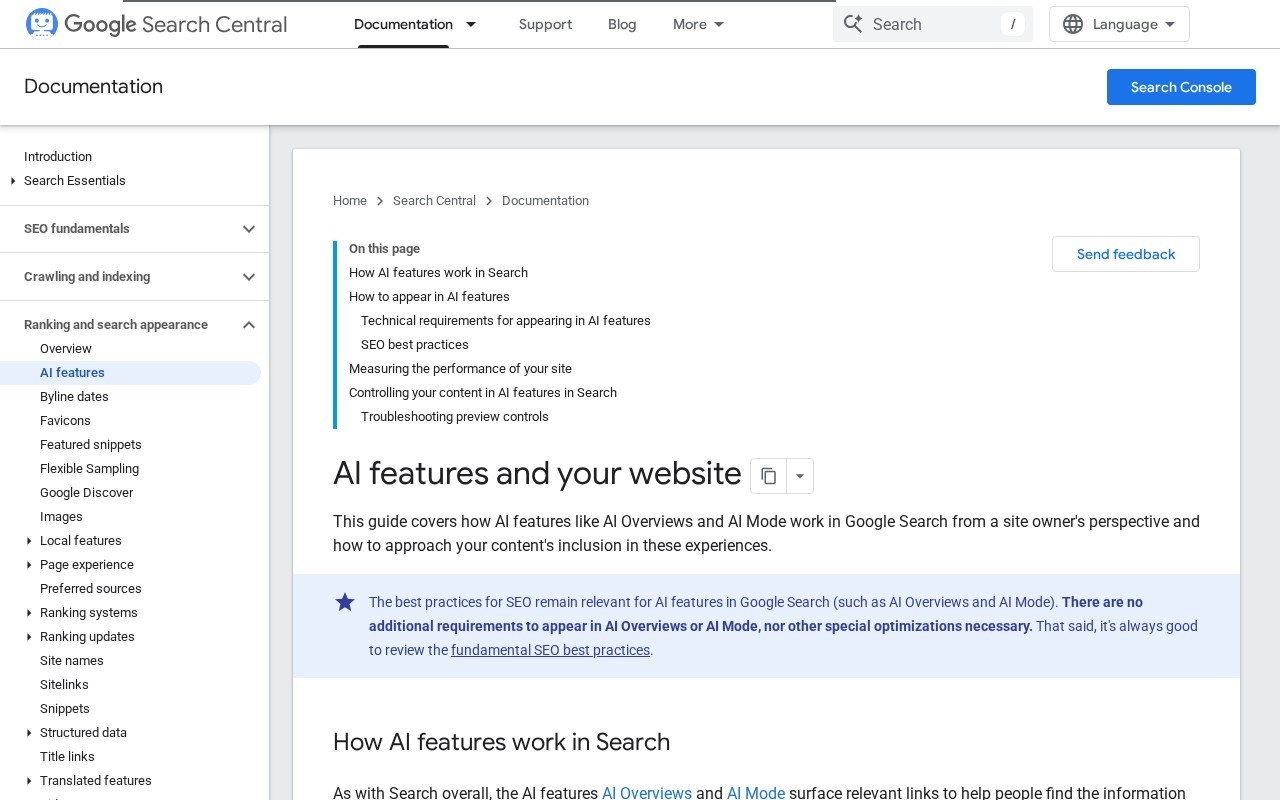
That statement covers Google's AI surfaces. It does not cover ChatGPT, Perplexity or Claude, which run their own crawlers and select sources on their own terms - and where signals like a clear llms.txt, direct answers near the top of a page, and specific dated figures do appear to matter. Worth keeping the two apart when someone pitches you on optimising for "AI search" as a single thing.
Why this matters more than it looks
For most sites, the interesting question is no longer only where they rank, but whether AI answers cite them at all. Until 31 August, that question had no data behind it - you either found your own site quoted by chance, or you did not know. A partial measurement is a large improvement on none.
The missing click data will likely follow. Google added impressions before clicks in ordinary search reporting too, years ago.
Common questions
Where is the report in Search Console?
Under Performance, alongside the standard web search report. If you do not see it yet, the rollout reached all sites on 31 August 2026, so a property that still lacks it is worth re-checking rather than assuming exclusion.
Can I tell how much traffic AI Overviews sends me?
No. The report gives impressions only, AI Mode traffic is not separated in the broader report, and referrer data is hidden. Anyone claiming a precise AI traffic figure right now is estimating.
Should I opt out of AI features?
For most publishers, no - opting out removes visibility without returning the click. It is a lever worth knowing exists, not one worth pulling by default.
Sources
- Google Search Central - generative AI performance report announcement
- CMSWire - reporting on the June rollout and its limitations
- Search Engine Roundtable - September 2026 Google webmaster report
This report will be updated if Google adds click data or referrer visibility. Last verified 8 September 2026.
Community discussion
Enjoyed this story? Share your thoughts below.