
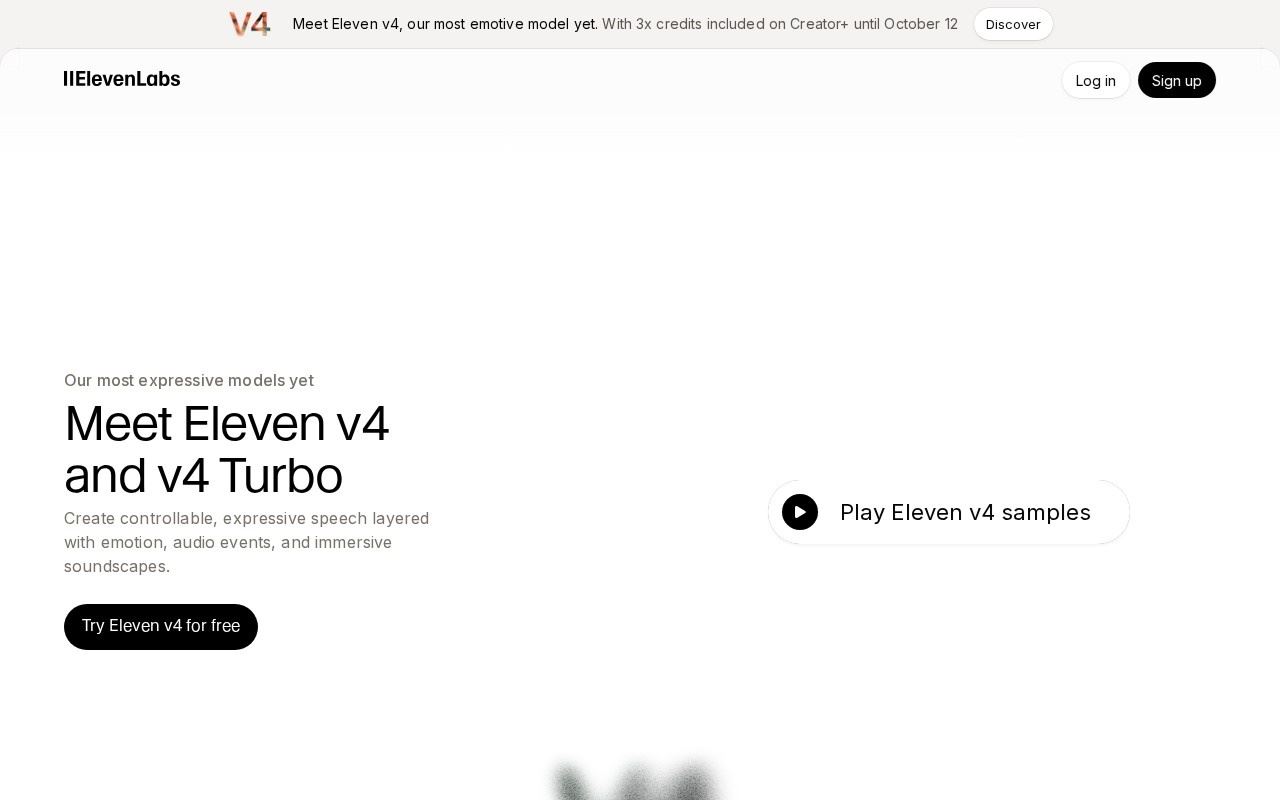
ElevenLabs released Eleven v4 and Eleven v4 Turbo on September 28, 2026. The pair replaces Eleven v3 as the default for anyone generating speech at volume. v4 is the quality model for produced audio; v4 Turbo is the low-latency variant built for voice agents.
The headline figures on the official v4 page, checked October 13, 2026: 90+ languages, 10,000 characters per generation, instant voice clones from ten seconds of audio, and a median inference latency of about 100 ms on Turbo.
This review reads the vendor's own pages - the v4 landing page, the documentation, and both pricing pages - and sets out what changed, what it costs, and who should hold off.
What Eleven v4 actually is
Eleven v4 is a speech model, not an app. You reach it inside the ElevenLabs web and mobile apps, through the API as model ID eleven_v4, and - in its Turbo form - inside ElevenAgents.
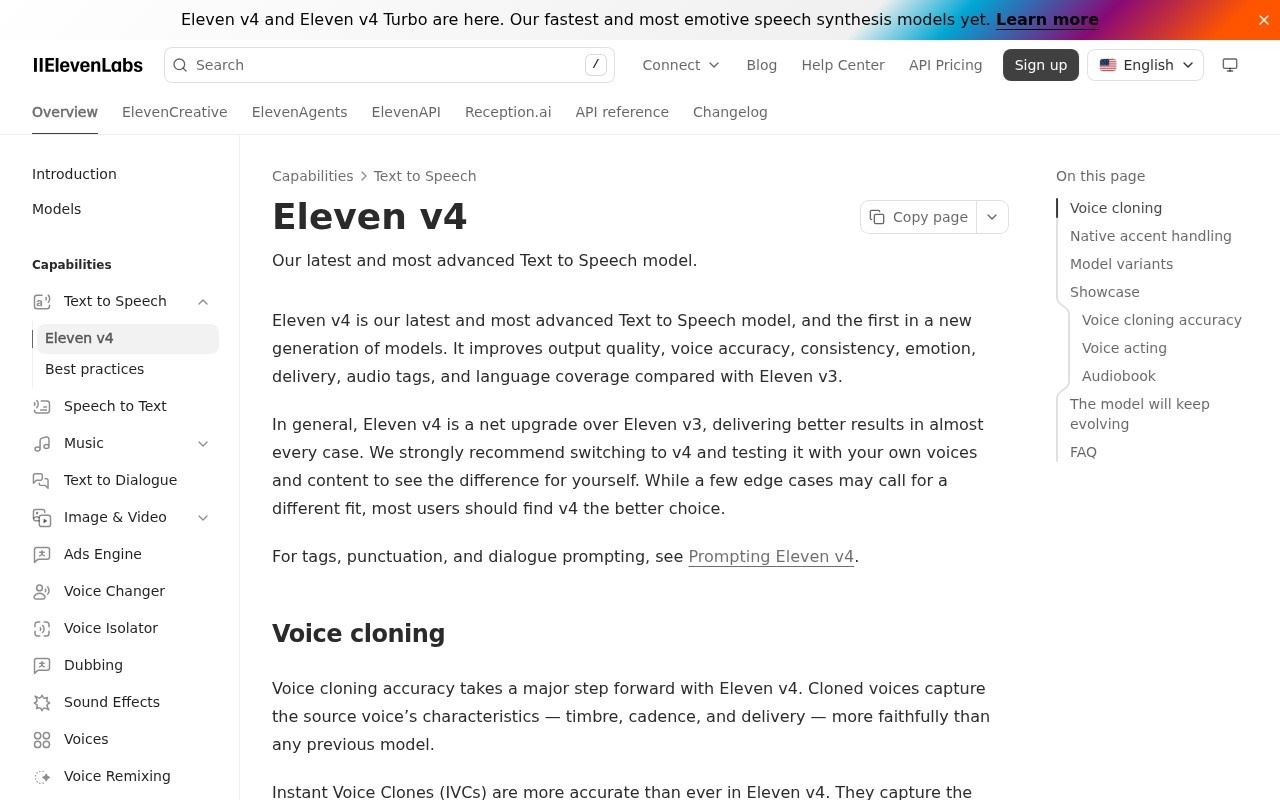
ElevenLabs calls it "the first in a new generation of models" and says it improves output quality, voice accuracy, consistency, emotion, delivery, audio tags and language coverage over Eleven v3 (documentation, checked October 13, 2026).
The control surface is inline audio tags. You write [whispers], [laughs] or [applause] into the script itself and the model performs them. SSML is not supported in v4, so the old break tag is gone.
Two voice settings remain, Stability and Similarity. The Style and Speed sliders from earlier models are not available in v4, per the documentation.
We did not run listening tests of our own. Everything below is read from ElevenLabs' own pages on October 13, 2026, plus two launch-day press reports.
This piece covers the model. For the platform around it - the credit meter, the plan ladder and what users report - see our full ElevenLabs review.
What changed from Eleven v3
Six changes matter, and the vendor states all six rather than leaving them to be inferred.
- Languages: 90+ in v4 against 70+ in v3, per the models documentation checked October 13, 2026. The v4 page lists each supported language by name rather than giving a total.
- Length per request: 10,000 characters in v4 against 5,000 in v3 - roughly ten minutes of audio instead of five.
- Professional Voice Clones: supported again after being unavailable in v3. Each existing clone is fine-tuned onto v4 individually from My Voices rather than migrating in bulk.
- Speaker consistency: ElevenLabs says speaker identity now holds across regenerations, so re-recording one line of a chapter should not change the narrator.
- Tag following: v4 "follows tag sequences more reliably than v3", per the v4 page, sound effects included, and tags can be stacked in sequence.
- Accent handling: when the target language differs from the reference voice's language, v4 now speaks with a native accent instead of carrying the original one across.
The Decoder, on September 29, 2026, reported a pronunciation benchmark moving from 85.6 percent on v3 to 91.7 percent on v4. That figure is not published on the v4 page we read, so treat it as a press number rather than a vendor one.
The accent change is the one to test before migrating. ElevenLabs describes it as deliberate, and says making it a toggle is "still a research project" with no timeline.
Who Eleven v4 is for, and who should wait
Four groups get a clear benefit from moving now.
- Podcasters and audiobook producers. The 10,000-character ceiling and context stitching are aimed squarely at long-form, where v3 forced twice as many joins.
- Course and membership creators narrating lessons in several languages, since one cloned voice now speaks each with a native accent. LearnWorlds and Teachable host the result.
- Newsletter and short-video teams turning written posts into audio - the same pipeline that feeds beehiiv issues or a Later content calendar.
- Voice agent teams, who want v4 Turbo rather than v4. The latency section below is the one that matters to them.
Three groups should hold off, at least for a cycle.
- Anyone whose brand voice depends on carrying its original accent into other languages. v4 drops it on purpose, and there is no switch yet.
- Teams with a large library of existing clones. Every instant and professional clone made before launch has to be retrained on v4, one voice at a time, from My Voices.
- Anyone who preferred how a voice sounded on v3. The documentation is unusually candid here: v4 is more accurate, and accuracy and preference are not the same thing.
If your audio is one piece of a wider funnel, the choice of model is rarely the bottleneck. Our marketing automation guide and newsletter platform guide cover what carries the audio once it exists.
Eleven v4 Turbo is the version voice agent teams want
Turbo trades a little quality for speed. ElevenLabs lists a median inference latency of about 100 ms and a median time to first speech of about 150 ms, on the v4 page checked October 13, 2026.
Read the footnote. The documentation marks those latency figures with a dagger reading "Excluding application & network latency." Your real call will be slower, and by how much depends on your own stack.
The v4 page also publishes a chart of median time to first speech: 150 ms for Turbo, 262 ms for Cartesia Sonic 3.6, 814 ms for OpenAI GPT-4o mini TTS. Those are the vendor's measurements, not ours.
Turbo supports bidirectional streaming, so audio comes back while the language model is still writing the sentence. It is reachable through ElevenAgents and through the Text to Dialogue WebSocket.
One practical gap: the character-limit table lists 10,000 characters for eleven_v4 and gives no figure at all for eleven_v4_turbo. If that ceiling shapes your design, ask support before you build around it.
Teams pairing an agent with a business phone line - Quo, for instance - should measure the end-to-end number their callers hear, not the model number on the marketing page.
What Eleven v4 costs
Credits, not minutes. The pricing page states one text character equals one credit on text to speech, and a single credit pool covers every ElevenLabs product, checked October 13, 2026.
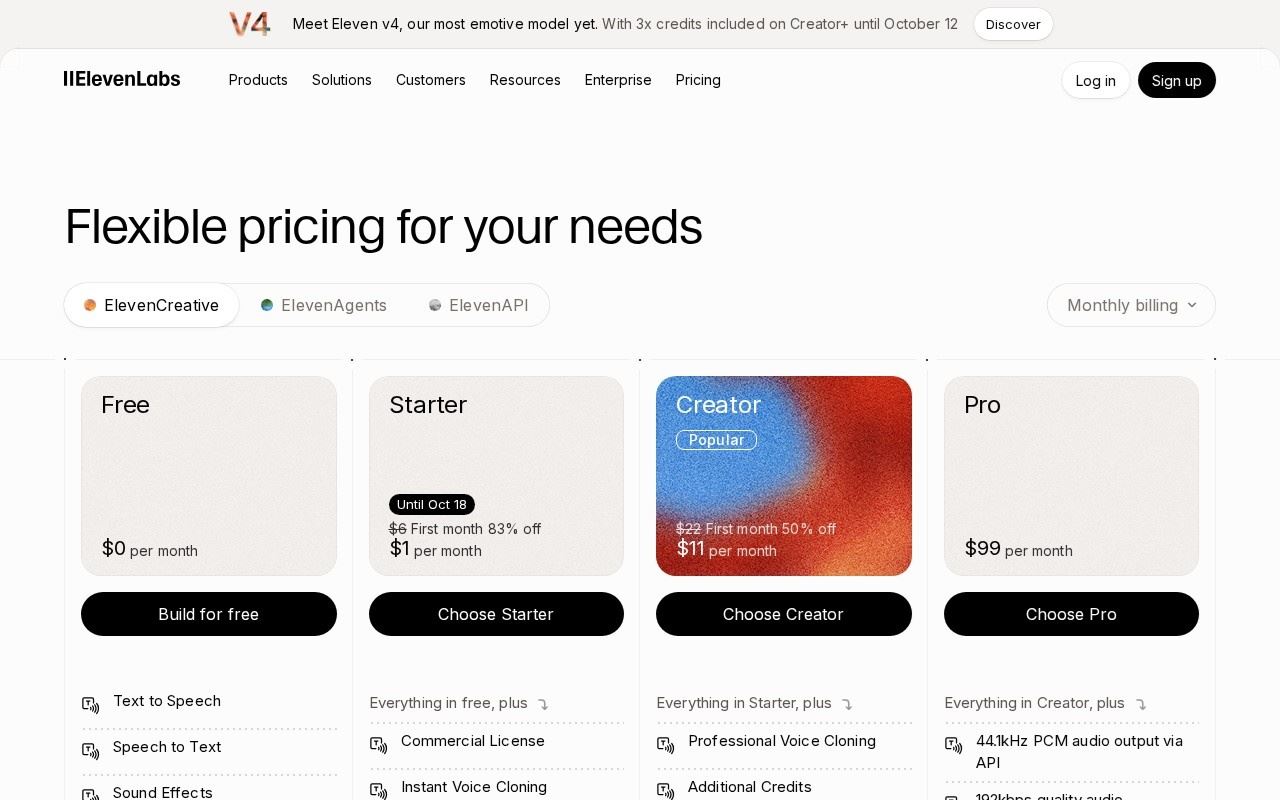
- Free - $0 a month, 10,000 credits, described as roughly ten minutes of audio.
- Starter - $6 a month, 30,000 credits. The page showed a first month at $1 until October 18.
- Creator - $22 a month, 121,000 credits, Professional Voice Cloning. First month shown at $11.
- Pro - $99 a month, 600,000 credits, 44.1 kHz PCM output via the API.
- Scale - $299 a month, 1.8 million credits, 3 seats. Business - $990 a month, 6 million credits, 10 seats.
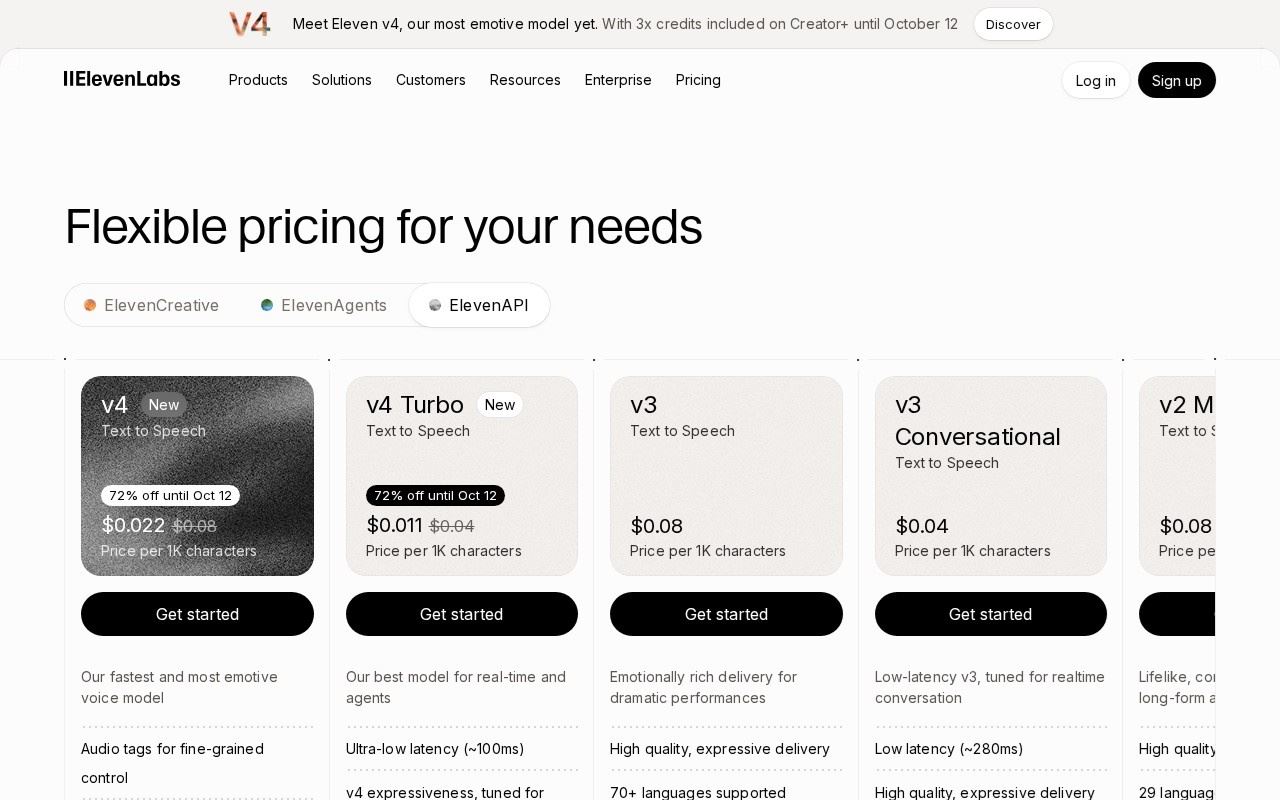
On the API the unit is characters. ElevenAPI lists v4 at $0.08 per 1,000 characters and v4 Turbo at $0.04 - $80 and $40 per million characters, by our arithmetic from those two figures.
Both were still showing a "72% off until Oct 12" promotional price of $0.022 and $0.011 when we checked on October 13, a day after that date. Budget against the list price, not the banner.
Unused credits roll over for up to two months, so a balance can reach three times the monthly quota. Which unit a vendor counts matters more than the headline figure - the same trap we unpicked in how email tools actually charge you.
Limits ElevenLabs states in its own documentation
The vendor documents its own rough edges, which is rarer than it should be. These are quoted, not inferred.
- Audio tags are "not perfect yet", and a tag can be read as a sound effect instead of a delivery instruction.
- Tags land more reliably when that delivery already exists in the voice's training data.
- Style and Speed sliders are gone, and SSML is unsupported.
- Voice Design voices work with v4 but "may not be as performative" as on earlier models.
- The model is under continuous training, so its behavior may shift after launch; ElevenLabs recommends re-testing periodically.
- Clean source audio matters more than before, because v4 reproduces flaws faithfully too.
On governance, the v4 page lists SOC 2 Type II, ISO 27001 and PCI DSS Level 1 certification, GDPR compliance and HIPAA-eligible workflows, and says scripts are not used for training without consent.
Every clone, instant or professional, requires verified consent from the voice's owner, and generated audio is detectable by the AI Speech Classifier. Neither point is optional; both belong in your team's process.
How to start with Eleven v4 in an afternoon
- Sign up on the free plan. 10,000 credits is about ten minutes of audio - enough to judge a voice, not enough to ship a chapter.
- Pick one voice from the library of 17,500-plus and generate the same 300-word passage on v3 and v4. The gap in accuracy is what you are buying.
- If you already have clones, retrain the important ones: open My Voices, hover the voice, click the plus button next to Eleven v4.
- Write tags into the script instead of reaching for sliders. Be explicit - the documentation notes that [low, gravelly voice] beats a tag that could read as a sound cue.
- For agents, switch the model ID to eleven_v4_turbo and measure time to first speech on your own stack rather than trusting the chart.
- Only then price it: estimate characters per month, multiply by the list rate, and compare with your current bill.
Budget a second afternoon for pronunciation. v4 reads IPA written between forward slashes, and pronunciation dictionaries still fix names and technical terms once for every later generation.
Sales teams adding voice follow-up alongside written sequences in lemlist or Apollo should sort out attribution first. Call tracking through WhatConverts is what tells you whether the voice changed anything.
Frequently asked questions
Is Eleven v4 free?
There is a free plan at $0 with 10,000 credits a month, which ElevenLabs describes as roughly ten minutes of audio, per the pricing page checked October 13, 2026. Paid plans start at $6 a month with 30,000 credits.
How is Eleven v4 different from Eleven v3?
v4 covers 90+ languages against 70+, allows 10,000 characters per generation against 5,000, supports Professional Voice Clones again, holds speaker identity across regenerations, and follows audio tags more reliably. All five are stated in ElevenLabs' documentation, checked October 13, 2026.
Do I have to retrain my existing cloned voices?
Yes. ElevenLabs states that instant and professional clones created before the v4 launch need retraining on v4 to work effectively. You do it from My Voices by hovering over the voice and clicking the plus button.
How fast is Eleven v4 Turbo, really?
ElevenLabs lists about 100 ms median inference latency and about 150 ms median time to first speech. The documentation adds that those figures exclude application and network latency, so measure your own end-to-end number before promising one.
What does Eleven v4 cost on the API?
List price is $0.08 per 1,000 characters for v4 and $0.04 for v4 Turbo, which is $80 and $40 per million characters. A "72% off" promotional price of $0.022 and $0.011 was still displayed on October 13, 2026.
Can Eleven v4 keep a cloned voice's accent in another language?
Not by default. When the generated language differs from the reference voice's language, v4 aims for a native accent in the target language. ElevenLabs calls a toggle for this a research project with no timeline.
Bottom line
Eleven v4 is the version to use if you are starting now. Longer generations, more languages, steadier speaker identity and Professional Voice Clones restored make it a straight upgrade on paper over v3.
The caveats are real but narrow: retraining an existing clone library costs time, the accent change can break a multilingual workflow, and the latency figures exclude your network. None of that argues for staying on v3.
This verdict comes from documentation, pricing pages and launch coverage read on October 13, 2026 - not from listening tests. How we grade sets out what that does and does not cover.
Try Eleven v4 with our referral link: https://try.elevenlabs.io/82fg00hx0gb0 - it is an affiliate link, it costs you nothing extra, and it does not change what we publish.
Sources
- ElevenLabs, Eleven v4 product page - elevenlabs.io/v4 (checked October 13, 2026)
- ElevenLabs documentation, Eleven v4 and Models pages - elevenlabs.io/docs (checked October 13, 2026)
- ElevenLabs pricing and ElevenAPI pricing pages - elevenlabs.io/pricing and elevenlabs.io/pricing/api (checked October 13, 2026)
- TechCrunch, "ElevenLabs' new v4 speech model supports more expression control and 90 languages", September 28, 2026
- The Decoder, "ElevenLabs' new v4 speech model makes AI voices more expressive and consistent", September 29, 2026
Community discussion
Enjoyed this story? Share your thoughts below.